
We are proud to announce that we are a myHappymind Bronze Accredited School!
This means that, as a school, we consider the mental health and wellbeing of our children as one of our top priorities. We have created a whole-school culture that helps build our children’s resilience, confidence, and self-esteem, as well as teaching them how to self-regulate during stressful times.
This Accreditation badge has been awarded thanks to all the effort our staff, children, governors, and parents have put in to bring the lessons of myHappymind to life across our school.
To learn more about the myHappymind for Schools programme, visit their website here:
Curriculum is difficult to capture in a single definition. At Norman Street, we picture ours as three cogs turning together: Relationships, the Core 3, and Knowledge & Experiences. Each depends on the others – take one away and the whole system stops turning.

Relationships sit at the centre of everything we do. Predictable, consistent routines – right down to the words adults use – build the safe, trusting environment children need before real learning can happen. We teach children about their behaviour and how to regulate it, and every system in school is designed to create more opportunities for relationships to grow, not fewer.
The Core 3 is the Normie code for effective learning, and so it is also the blueprint for effective teaching. Every adult follows it when planning a lesson; every child moves through it within a lesson.
We retrieve what children already know before we teach anything new – from last lesson, last week, last term, even last year. We are explicit with children about what retrieval is and why we are doing it, using consistent language across the school:
NORMIE LEARNING WORDS Retrieval
Retrieval means finding information that’s already in your memory and bringing it back out – like a memory detective!
EYFS: It’s like opening a drawer in your brain to find something you put there before!

We use whiteboards in classes to allow staff to assess children’s prior learning. We have consistent routines for achieving this as we know this helps to maximise learning time. Include show me board routine.
Adults model and scaffold new learning in real time, live in the teacher’s book, using precise subject-specific language and checking understanding continually, because without that check we cannot adapt the lesson. Scaffolding is not differentiation, and it is never as simple as ‘I do, we do, you do’ – in practice it moves back and forth, for example I-we-I, we-you-I, or I-we-you, as understanding develops.
We protect a culture where mistakes are safe to make, and we are careful with our language. Rather than ‘shout if you’re struggling’ or ‘hands up if you need help’, adults give children a clear choice: keep going confidently, or pause, watch the modelled example again, and re-join when it clicks.

NORMIE LEARNING WORDS Scaffold
A scaffold is the extra help adults give you when learning something new – once you’re ready, it comes off!
EYFS: It’s like stabilisers on a bike – they help you balance while you learn!
Careful activity design lets children show what they have learned, using the models and scaffolds from Step 2. In some subjects this means mastering fluency before moving on to application. Questioning, feedback and evaluation happen throughout this step, not just at the end.
GROUNDED IN RESEARCH
The Core 3 is grounded in Rosenshine’s Principles of Instruction (2012), the EEF’s guidance on Cognitive Science Approaches in the Classroom (2021), Sweller’s Cognitive Load Theory, and the evidence base for retrieval practice (Roediger & Karpicke). Resources are dual coded and consistently formatted, and classrooms are communication-friendly, low-sensory spaces, in line with our Inclusive Classrooms standards, because how we present information matters as much as what we present.
Central to the Core 3 is our staff. Teaching staff have a personalised professional development offer, built around StepLab’s instructional coaching cycle and EEF guidance, so that support is specific, granular and sustained, alongside time to develop subject knowledge and think about how to put it into practice. Support staff work within specialist teams, each with its own relevant CPD offer:
Some subjects are taught weekly; others in blocks. Where a subject is taught in depth over a half term, children finish with an application week that puts knowledge and skills into a real project. Subjects not being taught in depth that half term are revisited weekly in curriculum review sessions, so learning keeps building rather than being forgotten.
We deliberately give children time to immerse themselves in a subject, making purposeful connections to what they already know, and we space practice out over multiple sessions rather than one sitting, because that is how learning moves into long-term memory. Learning does not stop at the classroom door: our residential offer is purposeful and progressive, because some things can only be learned outside four walls.
Our Normie Motto – Kind, Brave, Fair, that’s the Normie Way – sits alongside this, giving children a shared, everyday language for Fundamental British Values: democracy, the rule of law, individual liberty, and mutual respect and tolerance.
We plan a curriculum rich enough for every child to have a full range of academic, spiritual, moral, social and cultural experiences – one that builds pride in British values and in the diverse community we belong to, and gives children the confidence and self-belief to aim high.
At Norman Street, progress means widening and deepening essential knowledge, skills, understanding and learning behaviours, not just covering content. Within the National Curriculum, we build in repeated opportunities to revisit and practise, so children move from acquiring facts to genuinely deep, connected understanding, at a pace that works for them.
The National Curriculum and the EYFS Statutory Framework are our floor, not our ceiling. By the end of each year group, every child will have a rich, secure body of knowledge and the skills to succeed at the next stage, with the same broad opportunities and the same exposure to the best of every subject, regardless of their starting point or barriers, so that their desire to keep learning carries on into adulthood.
Foundational Learning (ready to routines)
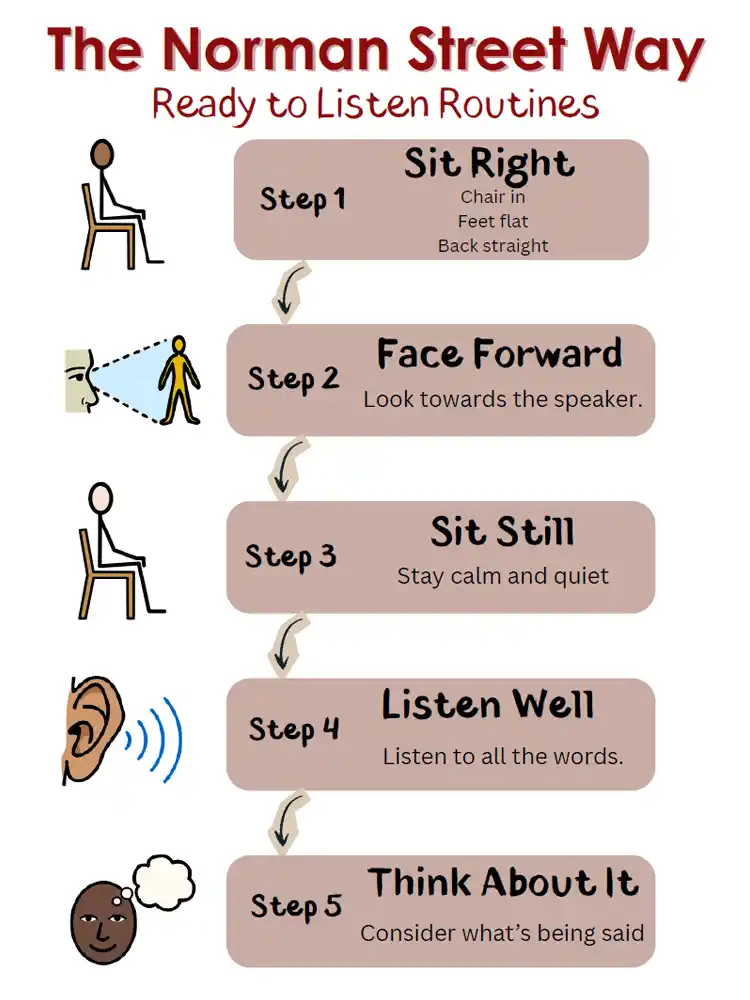


Before children can learn what we are teaching, they need to be ready to receive it — this is the thinking behind our four Ready to Routines. Ofsted’s Strong Foundations in the First Years of School found that the strongest Reception and KS1 curriculums build executive function, communication and language, and the physical foundations of transcription explicitly and early, rather than assuming children arrive ready-made or leaving these skills to develop informally.
Play is the process through which children learn everything that they need to know that cannot be taught. Play wires the brain, builds capable bodies and is the foundation of building relationships.
OPAL’s Programme enables schools to provide every child with rich opportunities to be creative, collaborative and active in their outdoor play, in environments that are safe enough for ‘Health and Safety’ but challenging enough for children’s ongoing development.


